


Structured Approach to Benefit - Risk Evaluation Under EU MDR 2017/745

What is Benefit Risk Calculation?
Benefit-risk calculation is the process of evaluating whether the clinical benefits of a medical device come before its associated risks.
In simple terms, it answers:
“Is the device safe and effective enough for its intended use?”
This evaluation is not just theoretical, it must be supported with clinical evidence, real-world data, and risk management analysis.
What is the Need for Benefit Risk Evaluation?
Benefit-risk evaluation is essential because:
- A device may perform as intended but still pose unacceptable risks
- Regulatory authorities require evidence-based justification of safety and performance
- It ensures patient safety remains the top priority
- The system supports decision-making and regulatory approval.
Without proper evaluation, even a well-designed device cannot be considered compliant.
Where is it Mentioned in Regulatory Requirements Under EU MDR 2017/745 ?
Benefit-risk evaluation is a core requirement under EU MDR 2017/745 and is referenced in multiple sections:
- Article 2(53) - Defines clinical benefit
- Annex I (General Safety and Performance Requirements - GSPR)
- Devices must achieve intended performance while ensuring that risks are acceptable when weighed against benefits -Annex XIV, Part A - Clinical Evaluation
- Requires demonstration of a favourable benefit-risk ratio based on clinical data
Challenges in Identifying Benefits and Risks
In practice, manufacturers face several hurdles:
- Difficulty in quantifying benefits
- Lack of sufficient clinical data, particularly for new devices
- Identifying all possible risks, including rare or long-term complications
- Separating device-related risks from procedure-related risks
- Bias in literature or clinical studies
- Aligning risk data with the risk management file (ISO 14971)
These challenges make benefit risk evaluation a complex and iterative process.
Why is it Important? (Role of Notified Bodies & Real-World Data)
Notified Bodies expect manufacturers to go beyond theoretical assumptions. They require:
- Real-world clinical data (Post-Market Clinical Follow-up - PMCF)
- Evidence that the benefit risk profile remains favourable over time
- Continuous monitoring of adverse events and clinical outcomes
This is why benefit-risk evaluation is not a one-time activity, it is a lifecycle process.
What is “Benefit”?
As per Article 2(53) of EU MDR:
“Benefit is the positive impact of a device on the health of an individual, expressed in terms of meaningful, measurable, patient-relevant clinical outcomes, including outcomes related to diagnosis, or a positive impact on patient management or public health.”
Meaningful Benefit
A measurable benefit is one that can be quantified using data or clinical endpoints.
Examples:
- Blood pressure reduced by 15 mmHg
- Tumor size reduced by 30%
If you can express it in numbers, then you can measure it.
Measurable Benefit
A measurable benefit is one that can be quantified using data or clinical endpoints.
Examples:
- Blood pressure reduced by 15 mmHg
- Tumor size reduced by 30%
If you can express it in numbers, then you can measure it.
Patient-Relevant Clinical Outcomes
These are outcomes that directly matter to the patient's health and quality of life.
Examples:
- Survival rate
- Pain reduction
- Ability to perform daily activities
- Reduction in hospital stay duration
These aren't only clinical figures; they reflect what patients really experience.
What is Clinical Benefit?
Clinical benefit is defined in MDR as:
“The positive impact of a device on the health of an individual, expressed in terms of meaningful, measurable, patient-relevant clinical outcomes, or a positive impact on patient management or public health.”
In simple terms, it is:
The actual effect experienced by a patient when using the device
Direct Clinical Benefits
These are benefits that are directly measurable through clinical outcomes.
It could be
- Pain relief
- Increase in functionality
- Improved survival rate
- Faster recovery
Example of Direct Clinical Benefit: Stent
- Restores blood flow in blocked arteries
- Reduces symptoms like angina
- Prevents major cardiac events
These benefits directly impact the patient's health.
Indirect Clinical Benefits
While these devices don't produce clinical outcomes on their own, they support procedures that lead to positive results.
It can be
- Surgical instruments
- Implant measurement tools
- Drug delivery systems
These align with MDR statement:
“Positive impact on patient management”
Example of Indirect Clinical Benefit: Guidewire
A guidewire does not directly provide clinical benefit to the patient.
However:
- It helps in accurate placement of devices like stents
- It improves procedural success and safety
- It reduces complications during intervention
Therefore, the guidewire contributes indirectly by enabling the direct clinical benefits of a stent, demonstrating a positive impact on patient management.
Clinical Performance
As per definition: "The ability of a device to achieve its intended purpose, thereby leading to a clinical benefit."
Learn More: Clinical Evaluation Plan (CEP) Guide for EU MDR & IVDR Compliance
What is Risk? (As per ISO 14971)
ISO 14971 defines risk as:
“A combination of the probability of occurrence of harm and the severity of that harm, where ‘harm' means physical injury or damage to the health of people.”
An Illustrative Example
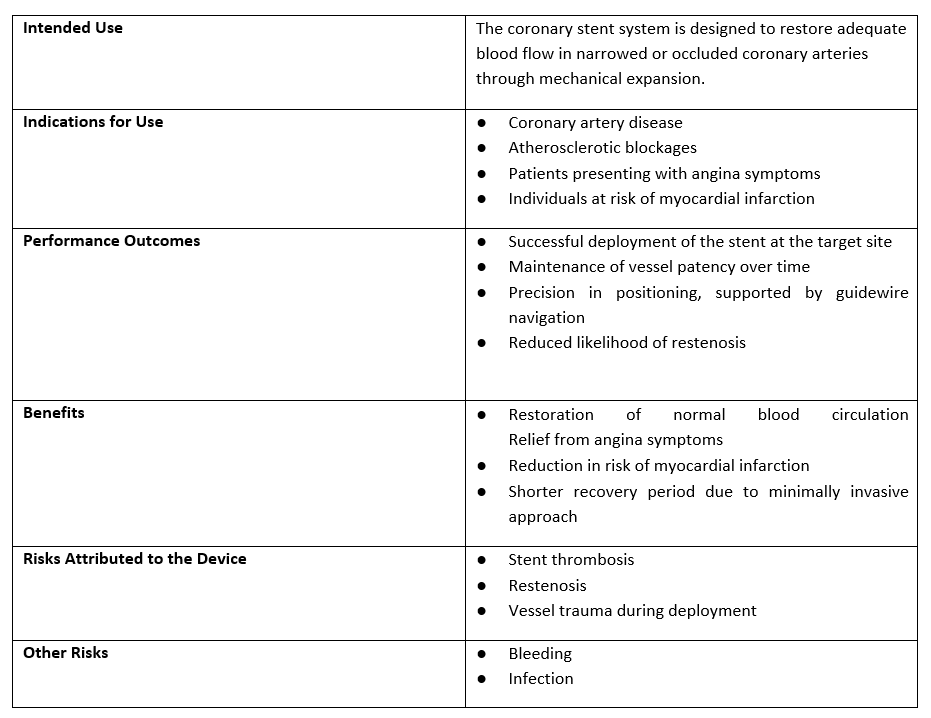
To demonstrate the application of the above principles, a coronary stent system used during angioplasty procedures was considered. Based on the device's Instructions for Use (IFU) and risk management documentation, a clear distinction was made between:
- Device performance parameters and actual clinical benefits
- Risks directly associated with the device and those arising from the overall procedure
Next Steps: Benefit-Risk Evaluation
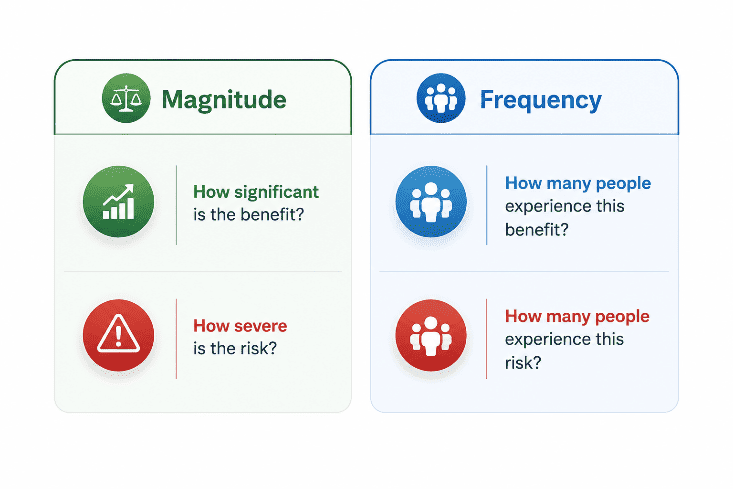
The subsequent step involves assessing the overall benefit-risk profile of the device. This assessment is primarily based on two key dimensions:
MAGNITUDE
- What is the clinical significance of the identified benefit?
- How serious are the associated risks?
FREQUENCY
- What proportion of patients experience the benefit?
- How often do the risks occur?
Regulatory Perspective
As outlined in MEDDEV 2.7/1 Rev. 4 (Section A7.2):
“A benefit of high clinical importance, even if observed in a limited number of patients, may outweigh associated risks, whereas a benefit of lower impact may only be meaningful if consistently observed across a larger population.”
Calculating Benefit-Risk Ratio
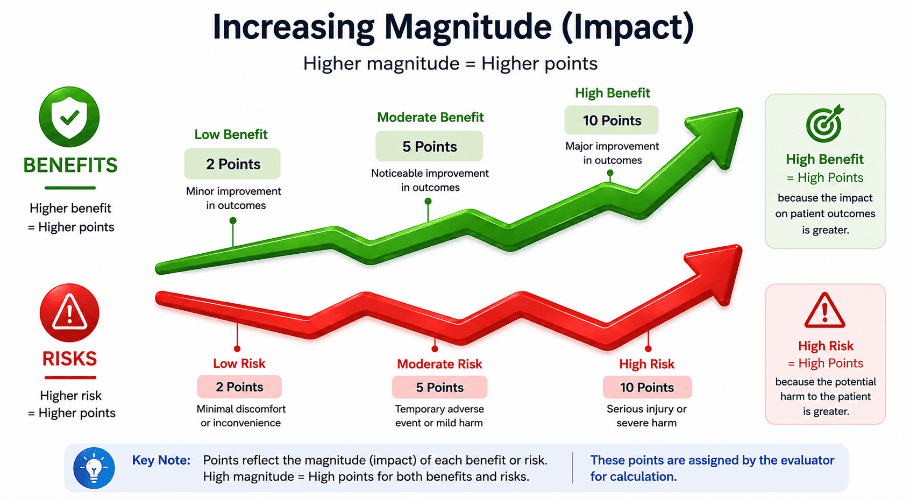
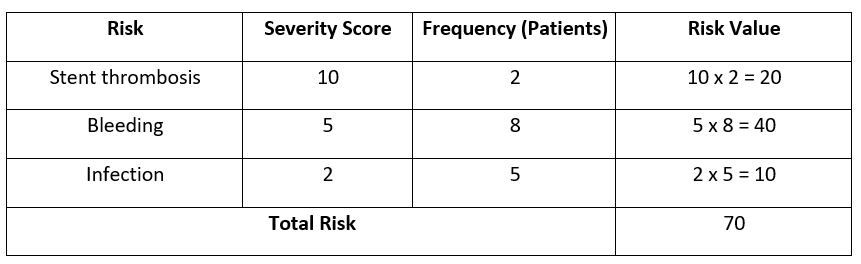
By combining frequency and magnitude, both benefits and risks can be quantified.
Formula:

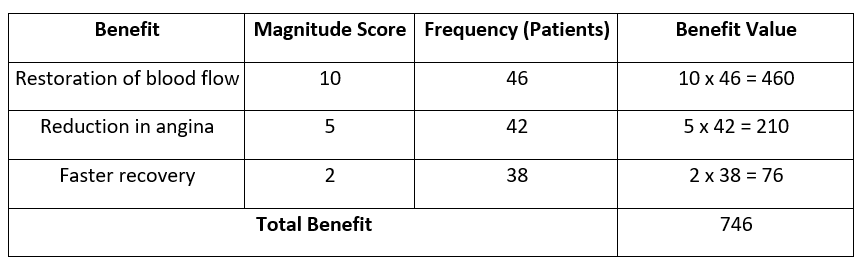
Benefits Evaluation
Risks Evaluation
- ✤
Benefit-Risk Ratio = Total Benefit / Total Risk = 746 / 70 = 10.7 > 1
The benefit-risk profile of the device is favourable and acceptable, as the benefit–risk ratio is above 1 and supported by the quantitative analysis, in line with the expectations under the MDR.
Reference:
- EU Medical Device Regulation (EU MDR 2017/745)
- ISO 14971
- MEDDEV 2.7/1 Rev. 4
- MDCG 2020-6
- MDCG 2020-13
Mistakes to Avoid
When a company has a plan in place they still make mistakes that can incapacitate how people see their evaluation of benefits and risks. The benefit-risk evaluation is very important. Manufacturers should refrain from creating these errors.
- Ambiguous device effectiveness with clinical benefit: A device operating as intended (e.g., accurate deployment) does not by default interpret into a clinical outcome. Clinical benefits should reflect meaningful health outcomes.
- Using subjective scoring without justification: When we score something we should use evidence from doctors and scientists. This means looking at what has happened in the past and what experts think. We should not just make things up. Magnitude and severity scores should be based on facts, not guesses.
- Ignoring low-frequency but high-severity risks: Do not ignore serious problems. Things like a device failing or life-threatening complications can really change how good or bad something is. The overall benefit and risk of a device should always include these serious problems. Rare adverse events, like these can have an impact.
- Failing to use current clinical evidence: We have to use clinical evidence when we do benefit-risk evaluations. This means we should look at the results from clinical investigations, literature and other data.
- Not aligning with the Risk Management File: We need to make sure our risk management is aligned with the Risk Management File. This file has information about the risks and hazardous situations that we have found.
- Treating the evaluation as a one-time activity: We should not think that benefit-risk evaluation is something we do once. It is a process that we need to review when we get new clinical evidence or post-market data.
Conclusion
Benefit-risk evaluation is one of the most critical components of clinical evaluation under EU MDR 2017/745. It demonstrates that the expected clinical benefits of a medical device outweigh its residual risks based on objective clinical evidence and sound risk management principles.
To make a device safe manufacturers look at the things it can do and the bad things that might happen. They score how big and how often these things happen. They use evidence to back up what they say. This helps them know if the device is an idea. They have to keep checking because new information comes out as people use the device. This way they can be sure it is still safe and works well
FAQs
1. Which are the aims of Risk-benefit analysis pursuant to the EU MDR?
To provide the evidence that the clinical outcomes of a medical device exceed its related risks.
2. Is Risk- benefit analysis obligatory for all medical devices?
Yes it is a regulatory regulation as per EU MDR 2017/745.
3. What norm is predominantly adopted for medical devices risk mitigation?
ISO 14971 is the globally established norm for medical device risk management.
4. Can post-market surveillance evidence alter the risk-benefit profile?
Yes, new clinical and post-market substantiation might necessitate the risk-benefit analysis to be modified
5. What signifies an advantageous risk-benefit ratio?
A ratio illustrating that the measured positive clinical outcomes exceed the measured residual risks, backed by research-based proof.
Share this blog
Read More Blogs
Medical Device Approval Process in Japan | PMDA and MHLW Guide

How to Apply Human Factors and Usability Engineering to Medical Devices

Understanding ICMED: India's Certification for Medical Devices
