


Quality Objectives: How to Set Measurable Goals for QMS Improvement

We are committed to continual improvement. Sounds good. But here's the real question:
“How will you know if you actually improved?
This is where many Quality Management Systems move from words to numbers. A Quality Policy tells people what the organization is committed to.
Quality Objectives take that commitment and turn it into something the organization can measure, monitor, and improve.
What are Quality Objectives?
Quality Objectives are the measurable goals an organization establishes to support its Quality Policy and improve the effectiveness of its QMS. They give teams something concrete to work toward.
Instead of saying:
We want to improve product quality.
An organization could set an objective such as:
Reduce repeat manufacturing nonconformities by 20% within the next 12 months.
Now there is a clear target.
Quality Policy vs Quality Objective
It is easy to mix these two up. Think of it this way
Quality Objective: How will we know we're getting there?
Example
Quality Policy We are committed to meeting customer requirements and continually improving our QMS
Quality Objectives
- Reduce customer complaints by 15% within one year.
- Achieve 95% on time delivery.
- Reduce repeat production nonconformities by 20%.
- Complete 100% of required employee training within the defined timeframe.
The policy provides the direction.
The objective gives that direction something you can actually measure.
What makes a good Quality Objective?
Not every target makes a good quality objective.
A useful objective should be clear, measurable, and meaningful to the organization.
Example
- Weak - improve employee training.
There is no clear wat to know whether this has been achieved.
- Better - complete 100% of required QMS training for applicable employees within the defined timeframe.”
Now the organization can track it.
Example
- Weak - improve customer satisfaction.
- Better - reduce repeat customer complaints by 15% over the next 12 months.
Quality Objectives should connect to real problems
This is where Quality Objectives become useful rather than just another QMS document. Suppose a company has noticed that the same manufacturing defect keeps appearing.
Instead of simply saying:
“We need better quality.”
The organization could establish an objective to:
Reduce repeat manufacturing nonconformities by 25% within the next year.
Now the Quality team can monitor the data, identify trends, review CAPA effectiveness, and see whether the actions being taken are actually making a difference.
The objective creates a reason to look at the data instead of relying on assumptions.
Who is responsible for achieving the objective?
A Quality Objective should not just sit in a Quality Manager's spreadsheet.
Someone needs to own it.
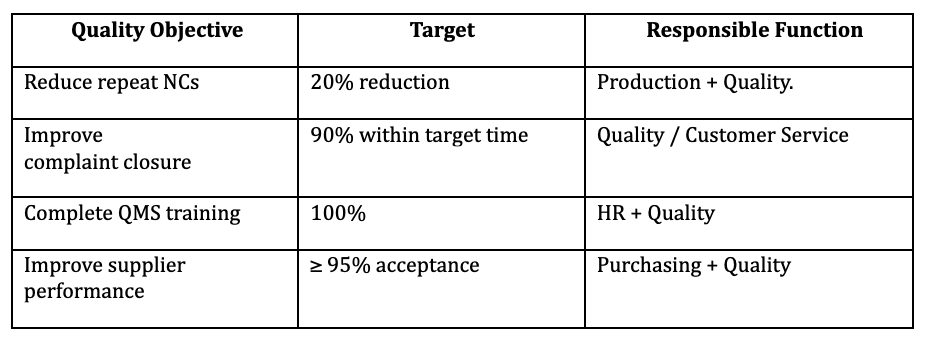
The exact targets will depend on the organization's size, processes, risks, and current performance.
And do not forget to review them
Setting a Quality Objective is only the beginning. The organization should monitor progress and asks:
- Are we moving toward the target?
- If not, why?
- Do we need additional resources or action?
- Is the target still appropriate?
This is where management review becomes important.
Quality Objectives should be based on actual information and should help management understand whether the QMS is performing as intended.
A common mistake
One common mistake is creating too many objectives. A company may end up with 15 or 20 targets because every department wants its own KPI.
The result?
Everyone has numbers to report, but nobody knows which ones actually matter. A smaller number of relevant and meaningful objectives can be much more effective.
Quality Objectives should help the organization improve not create another layer of paperwork
The real purpose of Quality Objectives
At their best, Quality Objectives create a connection between what leadership says and what the organization actually does.
The Quality Policy says
“This is what matters to us.”
The Quality Objectives say:
“Here is how we are going to measure it.”
And the data tells us:
“Here is whether we are actually improving.”
Final Takeaway
A Quality Objective should never exist just because “ISO requires it,” It should answer a much more useful question:
“What do we need to improve, and how will we know that we have improved?”
Because if you cannot measure the progress, it becomes very difficult to know whether your quality commitment is actually making a difference.
Quality objectives help organizations turn their quality commitments into measurable results by setting clear targets, assigning responsibilities, and monitoring performance. They also help identify gaps, support continual improvement, and ensure the Quality Management System (QMS) delivers meaningful results.
At V Reg Solutions, we help organizations establish practical, measurable quality objectives aligned with their business goals and ISO 9001 requirements, supporting effective QMS implementation and continual improvement.
Share this blog
Read More Blogs

Gap Assessment: ISO 11137-1:2025 vs ISO 11137-1:2006

Final Version of Medical Device Labelling Standard (NOM-137-SSA1-2025) by COFEPRIS: Essential Updates You Should Know