


AI vs Regulatory Consultants: Why Human Expertise Still Matters

CAN AI REPLACE REGULATORY CONSULTANTS? THE REALITY BEHIND THE HYPE AND WHY HUMAN EXPERTISE STILL MATTERS IN MEDICAL DEVICE REGULATORY AFFAIRS
If you work in medical device regulatory affairs or you hire people, who do you have probably been asked some version of this question at least once in the past two years: Can we just use AI for this? This is a question, Artificial Intelligence tools have really become very impressive, AI tools are getting better and better.
The answer is more complex than a simple yes or no. AI is undoubtedly transforming Regulatory Affairs and Quality Management.
They can:
- Read thousands of pages in seconds, draft documents that would take a junior consultant a full day, and surface regulatory guidance you didn't know existed.
- It can reduce manual work, improve efficiency, and assist professionals in handling large volumes of information. However, the idea that AI can completely replace a Quality Person, Regulatory Affairs professionals, or consultant is far from reality.
The technology is real. The progress is real, and the cost pressures that make AI look attractive are very real too. But here's what doesn't get said often enough; being technically impressive is not the same as being fit for purpose in regulated medical device work.
And the gap between those two things is not a small one- it's the gap that determines whether a product reaches patients safely, or gets stuck in a regulatory cycle that costs years and millions.
In industries like medical devices, pharmaceuticals, diagnostics and healthcare compliance is not merely about generating documents. It's about making choices that impact safety. These choices also affect product quality keeping the business running and following laws.
To oversee these tasks, you need people with discretion who can be held liable and have exposure addressing real life instances.
Compliance is really crucial in these areas It requires an understanding of what it means to make decisions that affect patients.
Product quality and business continuity are also important. Following laws and regulations is a part of being compliant. Professional judgement and accountability are essential, in industries. Real-world experience helps in making decisions.
This blog isn't here to tell you that AI is useless or that consultants are irreplaceable gods.
Those things are not true. What this is- it's an honest, grounded look at where AI genuinely helps, where it quietly fails, and why the human expertise behind regulatory work remains not just useful, but necessary.
NOTE: The question was never whether AI could do the task. The question was always whether it could do the task well enough in the right context, with the right accountability, when everything is one the line.
Comparison Table AI vs Regulatory Consultants
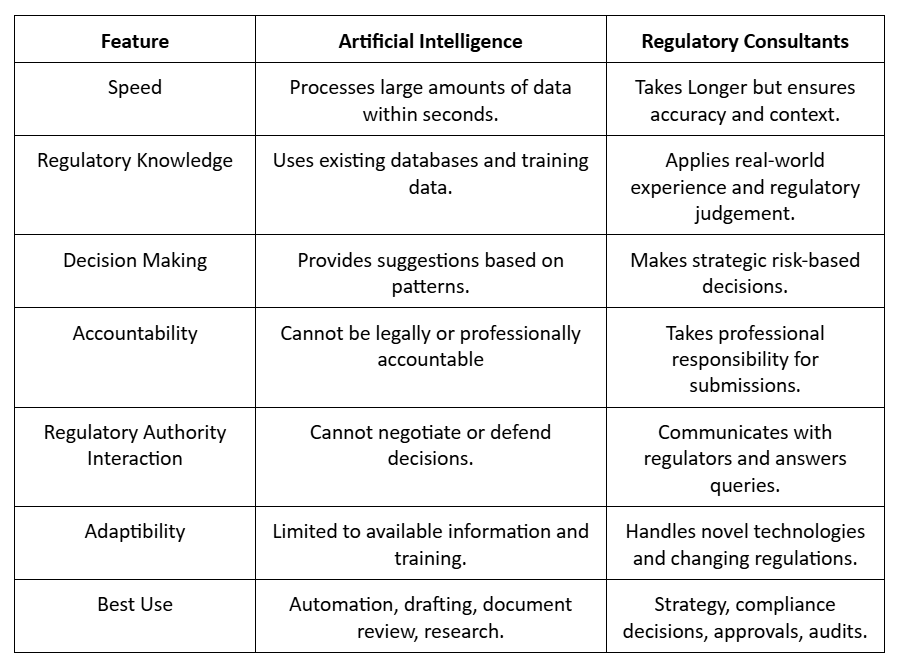
Why Do Companies Believe AI Could Replace Consultants? Why Do Companies Think AI Can Replace Consultants?
AI can create Standard Operating Procedures quickly, it can summarize regulations in a time, AI can help with literature reviews. Organize technical documents easily. It can also generate risk-management templates fast. All these tasks can be done in seconds. Compared with traditional manual processes, this feels revolutionary. Because of these capabilities, some organizations assume AI can perform the entire role of a consultant. However, this assumption overlooks the most critical aspect of compliance decision-making.
What AI Actually Does Well in Regulatory Work?
Let's give credit where it's genuinely due. AI has changed the way regulatory work flows in ways and pretending that medical device regulation does not work this way would be intellectually dishonest.
- Speed Through Vast Information
Medical device regulations are really an information field. The sheer volume of guidance documents, technical standards, clinical literature, and jurisdiction- specific requirements that a consultant must navigate is staggering. A modern AI tool, particularly one trained on regulatory corpora-can scan, surface, and summarize that information faster than any human. What used to take a team of people a week of database work to do for medical device regulation can now be done by the computer much faster for medical devices regulation done in hours. - Document Drafting and Structure
Regulatory submissions follow templates. Technical files have standard architecture. Gap analyses use familiar frameworks. AI is really good at helping to build the basics. It can do things like make a plan, for each section fill in text point out what is missing and make sure everything looks the same in big documents. When it comes to tasks that involve making documents, AI is a big help. AI can make these tasks go a lot faster. - Monitoring and Early Warning
Keeping up with regulatory change, new guidance, updated standards, and shifting enforcement priorities is one of the most time-consuming and unglamorous parts of the job. AI-powered monitoring tools can track global regulatory feeds, flag relevant changes, and summarize what's new in a given area. Used well, this dramatically reduces the cognitive load of staying current.
What Drives Regulatory Success?
Five Reasons AI Cannot Replace Regulatory Consultants.
- Regulations Require Interpretation
Regulations rarely provide straightforward answers. Experienced consultants interpret requirements and determine how they apply to a specific product. - AI Cannot Accept Accountability
If a submission is rejected or a compliance issue arises, responsibility belongs to qualified individuals and organizations not software. - Auditors Want Human Justification
During audits inspectors want to know the reasons behind our choices. They look for explanations, good reasons and facts to back up our decisions. AI cannot defend those decisions. - Experience Cannot Be Automated
Dealing with audits and CAPAs and complaints. Recalls and interactions with authorities for a long time. This experience gives insights that artificial intelligence does not have. Consultants learned a lot from handling audits and CAPAs and complaints. - Regulatory Strategy Needs to Understand Business.
Consultants balance compliance, timelines, cost, risk, and market-entry goals to create practical strategies.
Where the HYPE Quietly Falls Apart
Now let's talk about the part that doesn't make it into the product demos.
- Regulatory Work Is Not Just Information Retrieval
The deepest misconception about AI in regulatory affairs is that the job is fundamentally about finding the right information and putting it in the right place. It isn't. At this core, regulatory work is about interpretation, judgement, and advocacy under uncertainty. When a regulatory authority issues a new guidance document, the text is rarely black and white. Experienced consultants spend years learning how to read between the lines, understanding not just what the words say, but what they mean in practice, how they'll be applied by reviewers, and where the grey areas are going to create fiction. AI can read the same document. It cannot yet understand it in that layered, contextual way. - Novel Devices and Novel Problems
AI systems are trained on what has already happened. They are, by design, backward-looking. Medical device innovation, however, is forward-looking neatly into existing classification frameworks, technologies that regulators haven't encountered before, or clinical contexts that lack established precedent. In those situations, and they come up constantly in the real-world, an AI tool will either give you a confident-sounding answer based on analogous past cases, or it will tell you it doesn't know. Neither response is what you need. What you need is a consultant who can reason from first principles, draw carefully from imperfect analogies, and walk into a meeting with a regulator prepared to defend a position. - Accountability Has No Algorithmic Substitute
Here is a fact that every AI optimist in regulatory affairs eventually has to reckon with; when a submission is rejected, when a submission is rejected, when a device recall happens, when a patient is harmed, someone is accountable. That accountability cannot sit with a software tool. It cannot be distributed across a neural network. It lives with a person, and it should. Regulatory consultants do not just provide information or documents. They provide professional accountability. When people put their name on recommendation, they are also putting their reputation on the line. In a lot of places professional registration is at stake too, this makes them take a lot of care and be very careful about what they say. They have to think about what's right and wrong, which is something that artificial intelligence, no matter how good it is, just cannot do. People have to consider the parts of a recommendation and that is something that AI systems, like AI, cannot really understand or replicate when they are making a decision or signing off on something.
The Human Expertise That Can't Be Automated
Let's go specific about what experienced regulatory consultants actually bring to the table because this is where the AI replacement argument breaks down most visibly.
- Contextual Regulatory Intelligence
A senior regulatory consultant carries something that doesn't exist in any database; a mental model-built from hundreds of submissions, dozens of regulator interactions, and years of watching how regulatory interpretation evolves in practice. They know which reviewer types tend to focus on which aspects of a submission. They understand how enforcement priorities shift with political cycles. They can tell you, from experience, that a particular route to market that looks clean on paper is currently receiving heightened scrutiny, because they were in a meeting last month where someone mentioned it.
That intelligence is not written down anywhere; it cannot be scraped or trained on; it is generated and updated through continuous, active participation in the regulatory ecosystem. - Relationship Capital and Regulator Trust
Regulatory agencies are staffed by human beings, the path through a complex or contentious submission is often shaped as much as by relationships and communication style as by the technical quality of the documents. Proficient experts foster rapport with regulatory evaluators over the course of time. They grasp how to have interactions, when to remain unwavering and when to concede. These consultants also know how to present information in a way that a specific reviewer will find interesting. An AI can help write the letter; it can't be present in the room. The consultants are expert at navigating these interactions. They know the reviewers and their preferences. This helps them get the desired outcome. - Integrated Ethical and Clinical Judgement
Medical device regulation exists because of patient safety. Every regulatory decision has a clinical shadow somewhere downstream of that submission; there is a patient. Experienced consultants carry that weight consciously. They bring clinical understanding, ethical grounding, and a sense of responsibility that goes beyond compliance to the letter of the guidance. When a consultant recommends a more conservative labelling position, or advises a company to conduct an additional clinical study before submission, or flags a safety signal in post-market data that hasn't yet reached statistical significance, those are judgements that require exactly that kind of integrated, values driven reasoning. No current AI system is equipped for it.
The Persistent Gap: Why Complexity Keeps Outrunning AI
One thing to know about AI in industries is that regulatory environments keep changing. They are not fixed, and are influenced by politics and respond to new tech, evidence and failures.
The rules for devices around the world have gotten a lot more complicated, over the last ten years. The introduction of the EU MDR, ongoing FDA reform discussions, the emergence of regulatory frameworks for AI-enabled devices, new requirements around clinical evidence, software lifecycle management, and cybersecurity these don't just add more content to databases. They add layers of interpretation, precedent building, and strategic navigation that are inherently human scale.
How AI Is Actually Being Used Right Now
Away from the hype cycles and the vendor promises, here's what the regulatory community is actually doing with AI tolls and it looks quite different from the replacement narrative.
The current state of AI adoption in affairs shows a clear pattern; AI helps experts do their job better, it does not replace them. Consultants using AI tools wisely are getting work done, they are being more thorough and are now able to serve complex clients more effectively on a large scale. AI is making consultants more productive and capable. They can now handle clients because AI is being used to enhance their skills. Consultants are becoming more efficient in their work. That is not a story of replacement. It is a story of augmentation and the distinction matters enormously, both for how the technology is deployed and for the professional development of the people who use it.
The Verdict: A Reference Table
Here is a simple list of what Artificial Intelligence can do and what people are still better at. Think of this as a guide to help you; it is not a fast rule. The things that AI and people can do will keep changing over time.
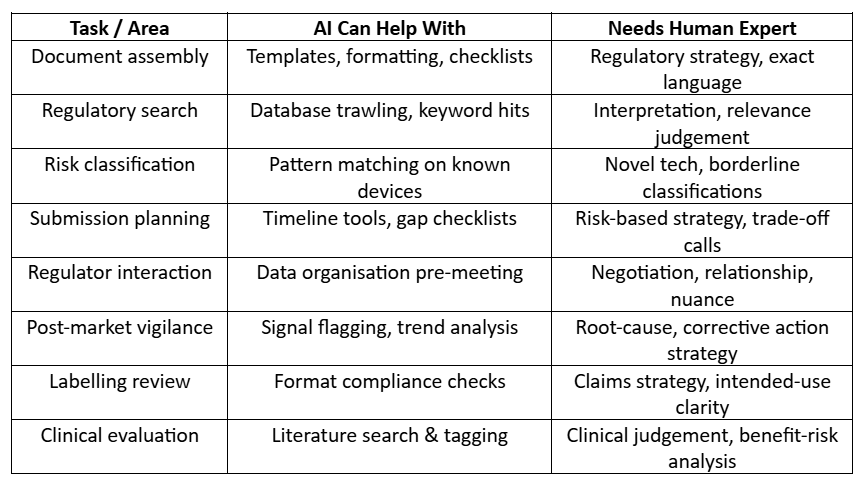
Table 1 - Task-by-task breakdown of AI utility vs. the irreplaceable value of human expertise. Most real-world regulatory projects will require both columns simultaneously.
What This Means for Regulatory Professionals
If you are a regulatory consultant reading this, you will probably feel some mix of reassurance and a quiet challenge. The good news is that what you know is still very useful. Your expertise is not outdated, it will not become outdated anytime soon. The thing to think about is that professionals who will do well are the ones who learn to use technology to help them work better. They will be the ones who are successful. Your expertise is important; it will continue to be important. The professionals who will thrive are the ones who learn to use what they know in ways these tools intelligently.
There is a real risk in this profession of treating AI as either a threat to be dismissed or a magic solution to be adopted uncritically. Neither posture is useful. The consultants who will be really helpful in the ten years are the ones who know the tools very well and use them when they are actually useful. They also need to be honest about when the tools are not helpful. They have to keep learning about the things that are specific to their field and build strong relationships with people because no computer program can do that.
Note: Leadership Teams Considering AI-Driven Cost Cuts in Regulatory Affairs: The process of getting a device approved is not something that can be easily repeated. If you make mistakes when you are deciding how to deal with regulations or when you are choosing how to submit your device for approval or if you do not have evidence, from clinical trials these mistakes can cause big problems later on and will be very expensive to fix. Before reducing your expert headcount in favour of AI tooling, ask whether your AI tools can sit in a regulatory agency meeting, defend a benefit-risk position, or take professional accountability for a submission decision. Until the answer is yes figuring out if something is worth it is not as easy as it seems when you look at the numbers, on a piece of paper.
Looking Forward with Honesty
It would be naïve to suggest that AI will never become more capable in regulatory affairs than it is today. The technology will improve. Regulatory specific AI systems, trained on richer datasets and designed with better safeguards, will emerge. Some of the tasks that require human judgement today may genuinely be addressable by AI in five or ten years.
But the honest version of that future still includes expert humans not because change is uncomfortable, but because the consequences of getting it wrong in this industry are measured in patient harm, not just business setbacks. The bar for replacing human judgement in a regulated healthcare context is rightly very high, and it will remain high regardless of how impressive the tolls become.
The more likely and more interesting future is one where the best regulatory consultants are those who have become sophisticated users of AI, where routine work is handled with greater speed and efficiency, and where human expertise is concentrated on the decisions that actually matter. That is not a lesser role. In many ways, it is a more demanding and more valuable one.
Final Thought
The question “Can Regulatory Consultants be replaced by AI?” Is, ultimately, the wrong question. It frames the conversation as a binary – human or machine when the reality is always more interesting than that.
The main thing to figure out is: How can we use these tools to make the regulatory process safer, faster and more accessible to everyone? We still need to have humans, who're experts and can be held accountable making the really important decisions. These tools should help us not replace the humans who're in charge. The regulatory process needs to be safer and faster. It also needs to be more accessible. Humans are still needed to make the calls. They are the experts. Should be accountable. We should use these tools to help humans do their job better. The tools are just that. They help humans make the regulatory process better. This is a question we should look into carefully without getting too excited or too scared.
The patients waiting for the devices at the end of the regulatory pathway deserve nothing less.
Conclusion
Can Regulatory Consultants be replaced by AI? In reality however it just can't. Artificial intelligence is a technology that assists people do their task refine and makes sure they follow the rules. We can't criticize intelligence for what it does. It is a resource; it can't make judgements. Also, artificial intelligence doesn't have experience like people do. It simply helps people get the job done. Artificial Intelligence does not have thinking. These things remain essential because they provide what Artificial Intelligence cannot: expertise. Artificial Intelligence is a tool that's very helpful but it is not a replacement for human people. Human people have things that Artificial Intelligence does not have. That is why human expertise is very important.
AI can create a document. A consultant ensures that the document survives an audit, satisfies regulators, and protects the business. The reason for this is that people who care about quality are still very important, with AI around.
FAQ
1.Can AI replace regulatory consultants?
No, AI assists regulatory work but cannot replace human expertise and accountability.
2.What is AI best used for in regulatory affairs?
AI is best for document drafting, research, data analysis, and routine compliance tasks.
3.Why are regulatory consultants still essential?
They provide strategic judgement, regulatory interpretation, and professional responsibility.
4.What is the future of AI in regulatory affairs?
AI and regulatory consultants will work together to improve efficiency and compliance.
Share this blog
Read More Blogs

Gap Assessment: ISO 11137-1:2025 vs ISO 11137-1:2006

Final Version of Medical Device Labelling Standard (NOM-137-SSA1-2025) by COFEPRIS: Essential Updates You Should Know
Medical Device Approval Process in Japan | PMDA and MHLW Guide
